
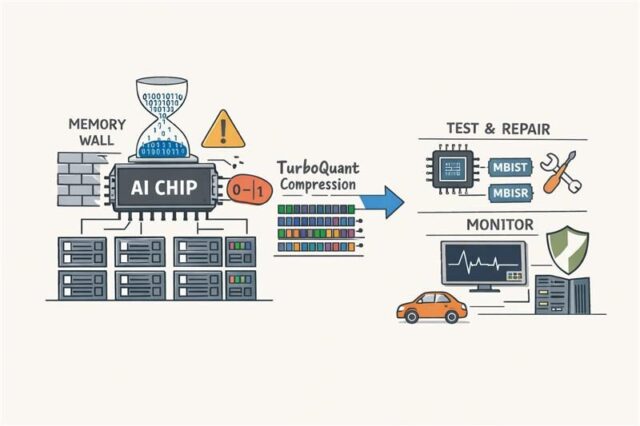
In an era where AI model parameters are growing exponentially, the “Memory Wall” has become a common adversary for all chip designers. Google’s recent unveiling of TurboQuant has undoubtedly sent shockwaves through the industry. This technology reveals a core trend for AI chip development over the next five years: how to extract maximum data value within limited space and bandwidth.
Higher Data Density, Lower Margin for Error
The core mission of Google TurboQuant is to optimize the KV Cache during Large Language Model (LLM) inference. It can compress data by up to 6x, meaning a model that previously required six servers might now only need one.
However, while we immerse ourselves in the “software dividend” brought by algorithms, the other end of the semiconductor supply chain faces a brand-new challenge.
It is a physical inevitability: as data is extremely compressed, the informational weight carried by each individual bit increases. In uncompressed data, a Bit Flip might only result in minor noise; however, under high-ratio quantization like TurboQuant, an error in a critical bit could lead to a total logical collapse of the inference result.
Furthermore, to accommodate such compression techniques, AI chips are integrating denser SRAM and high-performance memory architectures. As process nodes shrink to 3nm and beyond, the yield and long-term stability of memory units have become the deciding factors in whether an AI chip can be mass-produced and commercially deployed.
From “Functional” to “Durable”: The Indispensable Underlying Guardian
While the industry focuses on how AI can reduce memory consumption, the next step for chip designers is to consider: how can these highly strained memories maintain stable performance without failing? This is exactly the role iSTART-TEK plays within the ecosystem.
In the evolutionary path of High-Performance Computing (HPC) and AI chips, the Memory Testing and Repair (DFT/MBIST/BISR) solutions provided by iSTART-TEK serve as the safety foundation supporting software dividends like TurboQuant.
- Testing: Through advanced tools like START v5, iSTART-TEK embeds powerful MBIST (Memory Built-In Self-Test) functions during the chip design phase to accurately filter out defects.
- Repair: Utilizing MBISR (Memory Built-In Self-Repair) technology, the system automatically activates redundant space to repair bit errors when detected. This transforms potentially scrapped chips into functional ones, directly boosting production yield.
- Monitoring & Security: Throughout the chip’s lifecycle, monitoring solutions provide real-time health status of the memory. This is particularly crucial in HPC and automotive sectors where high reliability is non-negotiable.
The True Future of AI: The Convergence of Software and Hardware
The release of Google TurboQuant demonstrates the determination of AI algorithms to break through existing bottlenecks. However, the second half of this memory revolution will inevitably return to a competition over underlying hardware reliability.
From Google solving “how to save space” to iSTART-TEK solving “how to ensure quality,” it is only through absolute memory stability that software-side compression technologies can truly realize their full potential.