
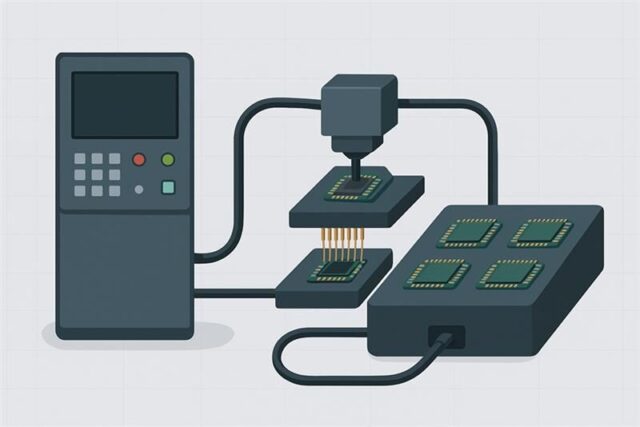
After a chip completes design, manufacturing, and packaging, one critical step remains before it can officially ship — ATE testing. ATE, short for Automatic Test Equipment, is an indispensable tool in semiconductor mass production. Its role is to ensure that every IC meets specifications in functionality, electrical performance, and quality, preventing any potential defects from reaching the market.
The Role of ATE in the Semiconductor Production Flow
From design to shipment, an IC goes through four main phases: design, wafer fabrication, packaging, and testing. The testing phase is further divided into two steps:
| Testing Stage | Target | Purpose |
| Wafer Sort | Bare dies on the wafer | Screens out defective dies to avoid easting packaging cost |
| Final Test | Packaged ICs | Verifies whether all functions and electrical characteristics meet specs |
Both stages rely on ATE to perform automated operations. Using a probe card (during wafer sort) or test socket (during final test), ATE connects to the chip and simulates electrical signals under real operating conditions, checking its performance across different voltages, temperatures, and frequencies.
What Makes Up an ATE System
A complete ATE system typically consists of:
| Module | Function |
| Tester | Provides power, clocks, and digital/analog signals |
| Handler / Prober | Automatically transports and positions chips |
| Test Program | Defines test items and pass/fail criteria |
| Load Board / Probe Card | Physical interface connecting the chip to the test system |
During testing, the ATE outputs various signals based on predefined test programs and collects the chip’s responses. Through high-speed measurement and comparison, the system quickly determines whether the chip passes the test. For complex ICs such as MCUs, SoCs, and memory devices, the ATE must support multi-channel operation, high-frequency signals, and large volumes of test vectors to ensure coverage and accuracy.
Why ATE Is Essential
In mass production, ATE is the first line of defense for quality, directly impacting overall yield and outgoing quality. Its main values include:
- Ensuring correct functionality and preventing defective products from entering the market.
- Monitoring process stability through test data and enabling early detection of abnormalities.
- Reducing DPPM (Defective Parts Per Million) to meet the stringent requirements of automotive, industrial, and communication applications.
- Enhancing production efficiency and reducing test cost through automation and data analytics.
For example, the DPPM requirement for automotive MCUs or memory ICs is often below 10 — meaning out of one million chips, no more than ten may be defective. Without high-performance ATE and rigorous test program design, achieving such a target is nearly impossible.
How iSTART-TEK Helps Improve ATE Test Efficiency
In ATE mass production, the test algorithm and test program are critical factors influencing coverage and efficiency. iSTART-TEK provides multiple test solutions for memory products that integrate seamlessly with ATE environments, including:
- MBIST / eFlash BIST IP: Built-in test logic that enables on-chip self-test, reducing ATE test time.
- UDA + TEC Algorithm Generation Platform: Automatically generates optimized test sequences based on the chip architecture and defect characteristics to improve test coverage.
- Test Data Analytics Tools: Integrates mass-production data to continuously refine test strategies and yield performance.
These solutions significantly enhance test efficiency and quality consistency without increasing ATE hardware load.
Conclusion
ATE is one of the most important components in semiconductor mass production testing and the final guardian of chip quality.
From wafer to finished product, ATE ensures each IC performs reliably across all application scenarios through fast and precise testing.
As chip technologies advance and test needs grow more complex, iSTART-TEK will continue delivering innovative BIST and algorithm-generation platforms to help customers achieve high coverage, high yield, and high reliability in ATE mass production environments.